
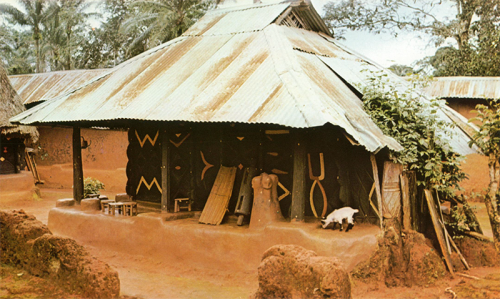
This essay was born from the spectrum of my observations while visiting Museums across Western countries, and it behooves me to tell this story in a non-linear paradigm. The central idea for this essay is to obscure the ‘established’ narratives about museums, culture, and technology, and to ‘construct’ the positionality of the digitalization of museums and aestheticization of artefacts in postcolonial Africa. As an observer, every detail of the picture I painted in this essay may not be wholly processed, but rather they are products of experience — the familiar gamut of all that I have witnessed.
Extensively, this piece takes a drift on the ‘trans-formation’ that occurs among African communities in accessing and ascribing their cultural heritage in museums across the world. I would warn my readers that this essay should never be taken as a ‘correctional facility’ for Western colonial anathema.
Since there is no intentionally collectively designed history of Africa, this contestation of who ‘benefits from what’ may not have arrived. Since there is none, myths about the African artefacts will continue to hold sway. Deirdre Pretorius, a professor of visual and cultural studies at the University of Johannesburg, asked if there exists a design of African history? Literally, we cannot really be furious with Pretorius’ curiosity. Any scholar or researcher should be embroiled in the same puzzle. To solve the puzzle, I would say that African history may not have been documented as modernity may want it, but it exists; the educational institutions and other agencies have not given it the voice it deserves.
My ontology emanates from the Igbo ancestral compendium, which is holistically underpinned using (traditional and modern) artefacts as ‘ways of living’ — court, trade, negotiation, mediator, and as ‘places of worship.’ I would opine that for anyone to be in the position to discuss digital (and other parameters of) museums, one would be ‘dopamined’ to have experience with what I may have called the ‘backend and frontend’ museums.
It is imperative to trace the digitalization of museums from the historical context of postcolonial rule. Postcolonialism operates from the spectacles of postmodernism that illustrate the forcible Western European cultural imposition on others: power, perception, and identity. Some observers may call it imperialism. This is relevant to museums in the West, in terms of collections and preservation of artefacts from the colonized hemisphere. As Jackson puts it, the Western museum is perceived as ‘holding space’ for a conquered territory.
Though some observers have indicated that artefacts like the Mbari (a ‘god’s tent’ worship and libation-pouring sanctuary or temple in the Igbo culture) are against being placed on display in glass cases for public consumption in museums. This implies that the Mbari artefacts cannot be preserved by human ideology — housed in a Western museum; it preserves itself and withers away when the time reaches. Originally, it was created to be ‘eaten up’ by wild beasts and other monsters — not to be preserved by human deliberacy. I will not be tempted to perceive Mbari as object status as Western anthropologists and ethnographers would do (italic mine).
The Mbari artefact and the Benin Bronze are an assemblage of spiritual polymaths that perform the unsystematic third-party negotiation. It is the ritualization of the entire Igbo heritage and the reproduction of traditional insignia from generation to generation, sustained through quantamental affiliation with ancestral privileges. The Mbari artefacts resist/abhor digitalization for performative reasons.
Rowlands & Graeme noted that digital technologies in museums rival the sacredness of some artefacts, highlighting the preponderance of digital coding and their ‘potential re-entry into community life.’ In other ways of seeing what digital museums portray, Macdonald’s work has demonstrated the ‘application of digital heritage technologies to cultural preservation, such as the use of digital imaging to restore paintings, sculptures and monuments that have suffered degradation or are at risk of destruction.’ For Sansome, a digital museum means a “democratizing zone in which relations of otherness and constructions of identity are produced, that is, forms of recognition of local, regional and national emotional affiliations.”
Digital museums, according to postmodernists, serve as a mechanism for education, particularly from the perspective of ‘transmission, inheritance and inter-generational learning, with the chances of reconnecting with museum collections, through witnessing and observation, which would otherwise be inaccessible.’ Procuring the arguments from how young people show interest in smartphones, technology is a watershed to retain them and bring to life the dissipation of traditional knowledge.
A visit to some Western Museums’ websites tells entirely different stories about the ‘imprisonment’ of African artefacts. Baudrillard’s analysis was featured differently. For him, digitalization of museums means manipulation of the details and obscuring the values held by some artefacts as designed by the inventors. Baudrillard would not have put it better. Moving forward, what Rowlands & Graeme and Macdonald failed to recognize is that the ‘act’ of reconstituting artefacts for modernity’s sake means repeating the old-fashioned emasculation of the museum into a caricature.
What is not yet in public knowledge is that this is some kind of shrivel pixelation repeatedly conducted by capitalism to jettison the effort of decolonizing Western Museums — even though decolonization or deconstruction of museums is not entirely different from postmodernist projects. I need someone to provide evidence-based research to disprove my convincing argument that the digitalization of museums does not imply a heavy monetization of access to historical symbolism and totemic concepts, thereby giving credence to state capture and disenfranchising the marginalized groups from (free) accessibility.
In conclusion, ethnography and anthropology (even historiography) may frown at the promises this essay bears. However, this will not change the observation that digital museums do not reflect restorative justice, acceptance, humility, and indigenous reliance on the ethos of technology. While I acknowledge not being in a position for decision-making on how Western Museum galleries are orchestrated, it is within my epistemic right to justify how ‘unhealthy’ African artefacts have ‘be-come’ in Western Museums. The Museum is a (conceptual) space that restores the vitality of social memories of ethnic minorities and biocultural movements, and of national reminiscence in general. In that regard, the idea of technologizing an archive and museum of living memories, transmitted on the Internet, is an invitation for a sustainable dialogue on issues that concern material and immaterial ethnic heritage, including interested users. If this dialogue fails to serve as a bridge, then no one should claim to have served justice.
Image credit: Herbert M. Cole (1969)
