

From the purview of hindsight, the post-COVID era could be described as the era of algorithms. This is partly because the pandemic made the global community rely heavily on digital platforms. An algorithm is a seventeenth-century term that has become popular among tech-savvy individuals and a community-lifestyle-like word used often. It’s rare to read through books, journal articles, or essays on ‘concerning’ subjects without coming across the word ‘algorithm.’ Most tech writers and social media ‘influencers’ (a self-acclaimed title) seem to bury themselves in this word, using their platforms to domesticize it. I wonder if we are paying attention that even ALL-gorithm would have been aware of how ‘human-people’ have commercialized its name in increasing messiness. It’s going to scare it.
I am not yet a parent and have no personal experience in parenting, which makes me wonder if I am ‘disapproved’ of reflecting on such a sensitive yet complex topic that affects how we live. Surely, I may not have experienced parenting in the ‘crude’ sense of it, but I have ‘be-come’ a parent through my act of public service and social responsibility as a ‘global citizen.’ To an ‘individualistic mindset,’ this may be understood upside down since it does not respond to the meaning of a parent or the gerund of parenting. However, I understand that the way people respond to matters is different, which explains the peculiarity of human tenderness.
If there are some qualified professional to talk about parenting in this age of advanced technology, I would recommend a psychologist who deals with family traits and emotions, a psychotherapist who has worked around the clock to counsel parents about children’s mental growth, a lawyer who majored in family cases like divorce, wills, etc., an educationist who is willing to provide an instant feedback and practically legislate on mediated consciousness, and a TV Host who anchors children series and advocate for children’s right on ‘organized’ tv programs. ‘Parenting, teaching, and creating are no longer separate disciplines but converging practices in the same cultural struggle: to restore depth to a mind flattened by immediacy.’ This is why this set of anchors could be a good fit for this conversation.
“Culture,” naturally, has been deciphered in many ways. In this essay, I will not go into details of different deciphering of culture, but rather, in line with the question this essay is exploring, I would assert that parenting can be culturally defined as capabilities, customs, beliefs, and patterns acquired through the deliberacy of being a member of a society. This implies that making a positive contribution to the lives of the deserving has earned me the medal of parenthood. As much as I would like to be honest — modern parenting is challenging.
In the first paragraph, you may have realized that I purposely transverse from algorithm to an invented ‘ALL-gorithm’ due to the importance of time and space, and to provide us with the leverage of seeing algorithms in different ways. I am interested in everything that got in the room of what Roger Clarke called “dataveillanc.” All-gorithm accustoms culture in the sense of a general gamut of rules or obligations, forming part of conscious awareness. This is what it means to be attuned with other ways of knowing. According to Livingstone, out of three children you meet, one has access to the internet.
To cap it all, children’s experience and/or perception as users of the internet is magnificently shaped by ALL-gorithmic environments. Yet, little or nothing intricate has been done for the better interest of children, even though some dominant platforms have features like ‘parental control.’ As recently asserted by Mauk, in her 2023 article titled Parenting and the Algorithm: A Perspective on Parental Controls and Guilt Amid Digital Media, the term parental control and its utility offered on platforms provide families with a sense of empowerment through a suite of technological affordances.
The comic side of it is that it costs some money to use parental control on devices. If the logic for hosting ‘parental control’ on social platforms is to grant parents the privilege to control screen time limits, filter disturbing content like violence, verbal and non-verbal vices, adult material, etc, to ensure children’s digital safety and rights, then why does it come with a cost? One may think that such initiatives — aimed at protecting children from harmful content should be a brunt bore by the tech companies. I mean, it is infamous to generate this discourse without questioning the rationality behind the factors.
Now, what matters…?
It is significant to infer that Science and technology research shows that ‘ALL-gorithm,’ Big Data, Artificial Intelligence, culture, and society are inseparable (Figure 1). The prevalence of society is akin to the efficacy of algorithms, as a huge influence is wielded on children. Hugo Messer writes on Medium that “AI has quickly woven itself into my family’s daily life. My teens casually ask ChatGPT to double-check their math homework; my youngest loves quizzing Alexa about everything from dinosaur facts to today’s weather. This technology often feels like a helpful tutor or a clever toy.” He went ahead to narrate how this has become a nightmare in his home; hours of TikTok clips, scrolling through Instagram reels, and eyes-glued on YouTube Shorts clips.
From another sphere, platforms that use AI iteration are designed to gather engagement. That is how it survives. More clicks lead to more data (an example of Big Data captured in Figure 1). What this means is that your child’s favorite apps are engineered in a way to make them rely on the app — to always come back — in some cases at the expense of their attention span, emotional regulation and patience. The algorithms created by social media feed kids with the kind of content that appeals to their fantasies and gives them some dopamine props. However, while this may seem mild, unconsciously, it creates bubbles that fortify unfeasible standards, diffidence, and even mental health challenges like depression and anxiety.
‘ALL-gorithms’ are gradually dominating space and gaining influence on young people’s well-being, adaptation, learning, and future development. In Figure 1, the dotted line illustrates the interaction between culture/society and ALL-gorithm/Big Data/AI. The line vertically shares space with all the variables in the enclosed circle, a major attribute in understanding how children’s evolving relationships with algorithms manifest seamlessly. See the diagram below. Children’s lives are becoming increasingly interconnected with algorithms.
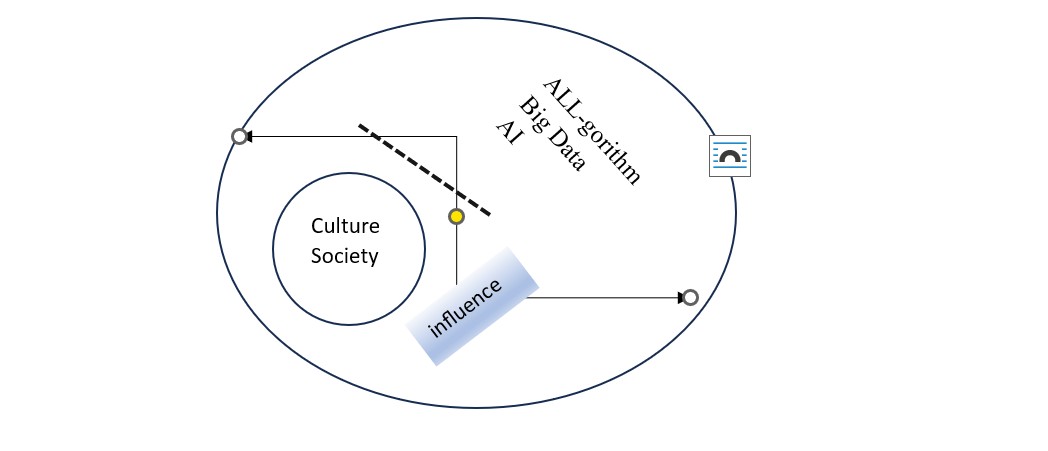
Figure 1. A Conceptual Model of ‘ALL-gorithm’ and Socio-Cultural Influence (designed by Compassion Chidozie, 2025©️)
The impacts of algorithms on the systemic dynamics encountered by children in schools, entertainment industries, and organizations are variably reproducing what I may call ‘meso-parenting.’ Meso-parenting means when parents are directly or indirectly ‘keeping alive’ the machinery that threatens their roles as parents. As one author poetically stated, “To raise a child is to participate in the slow evolution of goodness itself: to take what came before you and make it, somehow, more kind, more aware, more free. The art of parenting, then, is not the art of shaping another life, but of allowing love to shape your own, until what remains is not a masterpiece, but a mirror of the person you tried, day after day, to become.”
To participate in the curation of consciousness is similar to being in a child’s life. Once the process begins, we are not just teaching, mentoring, rearing, guarding, reading, writing, or empathy, but rather we are co-creating rhythm, the tempo of perception, the consciousness to know when to pause and listen, the temperament to restrict judgment, to seek and imagine before consuming. An article published by Tinyblog asserted that “To parent in this age is to resist the algorithmic impulse to optimize every moment. It is to teach a child that waiting is not emptiness, but a form of presence. That boredom can be a beginning. The parent of the future is not merely a caretaker but a curator of attention.” That what it means to be ‘parent-ing’ in this time is beyond collateral happenstance but summoning the hidden (animalistic) gestures to navigate the fastness of time.
In conclusion, this essay is not aimed at contradicting the importance of (educational) technology in the lives of children. Still, it is rather an invitation to notice the challenges —particularly in relation to technology addiction and loneliness that arise from internet insecurity. Moreover, it is aimed at creating awareness of the impetuous role of ‘ALL-gorithm’ in shaping parenting practices in everyday life (parenting is shaped by algorithms through search engines, social media, news, kids’ entertainment, etcetera). This is a call to initiate strategies beyond the fabrics of Big Data and AI to raise children who are emotionally intelligent, mentally capable and socially resilient.
There are existing studies on how AI has improved a child’s learning. Returning to Maureen Mauk, “…in the world of digital parenting that we have come to accept as normal, the parent is the gatekeeper, the censor, and the protector of children amidst an onslaught of capitalism and self-regulation” — this is what she describes as “responsibilization.” Modern family life is embroiled in the rise of Artificial Intelligence as it offers benefits alongside awareness of its associated concerns. ‘Artificial intelligence systems, in their promise of efficiency and prediction, threaten to compress the psyche into the instant. The very spaces where reflection once bloomed, therapy, art, conversation, and childhood, are being colonized by technological immediacy.’
“Digital literacy must be taught alongside emotional literacy, not as a defense against technology, but as an initiation into ethical perception. In this way, parenting becomes a form of aesthetic education. To guide a child through the noise is to perform the oldest artistic gesture: to frame, to filter, to compose experience into meaning.” Practically, some legislation is aimed at banning the use of smartphones for children below fourteen, while some schools are even more serious about expelling any student caught using AI for school projects. Some parents vowed to keep their children away from the algorithmic environment until they clock ‘maturity’ age. Critics perceive this as ‘extreme,’ but its outcomes imply maintaining organic integrity in learning and inculcating ethical standards in pedagogical practice.
Photo credit: Stephenellcock
