
This is my master’s research thesis at the Institute of African Studies (IAS), University of Leipzig, submitted on 13 March, 2025. It is out of goodwill that I published this work on my website as “open access” so that researchers, students, or interested individuals can easily read and freely download my thesis without subjection to a second party.
Having said that, I would admit that the EU CBAM is a full-fledged mechanism, and this thesis covers a mere percentage of what the policy entails. No researcher would claim to understand how the EU CBAM works because the ‘subject’ is still evolving. This is a novel introduction in the EU climate policy. Therefore, I anticipate your feedback in the form of criticisms, comments, and reflections.
I understand that this topic is complex and controversial because of its political underpinning; however, as it embarks on different phases, the EU Commission is strategizing its ‘Net Zero’ and renewable energy transition playbook for its own economic benefit and to prioritize its competitive edge in the period of global economic uncertainties.
Abstract
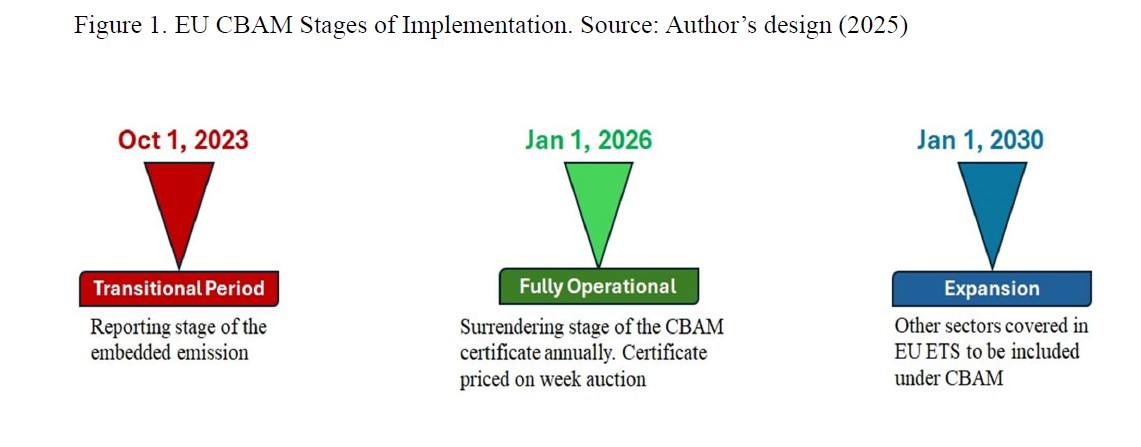
In line with the climate neutrality target and European Green Deal, on 1 October 2023, the
European Union implemented the proposed Carbon Border Adjustment Mechanism (CBAM)
in its transitional phase, which seeks to mitigate the significant risk of carbon leakage by
assigning a price on carbon-intensive products imported into the EU. The targeted carbon-intensive
products include aluminum, cement, electricity, fertilizer, hydrogen, iron and steel.
European importers of these goods are mandated to monitor and report greenhouse gas
emissions embedded in their imports from outside the EU. A certificate is acquired with
registered national authorities which will be surrendered annually for ‘offsetting’ the emissions.
The CBAM is a replacement for the free allowance allocation under the EU Emissions Trading
System (ETS) to encourage the decarbonization of industry. As the EU moves towards fully
implementing CBAM, there are concerns about its impact on trade relations with Africa, most
importantly, those countries heavily reliant on the EU market to export carbon-intensive
products. Strategically, South Africa is the largest EU trading partner in Africa. This study
examines the implications of the CBAM on trade relations between the EU and Africa, with a
specific focus on South Africa’s economic imperative. Utilizing discourse analysis (DA) as the
conceptual framework with qualitative research methodology, the study aims to unpack the
complex dynamics of CBAM in conjunction with its impact on trade and economic
sustainability in South Africa. The findings contribute to understanding climate policy
negotiations on the international stage, providing insight into the opportunities and challenges
for developing countries in the evolving global trade and environmental governance landscape.
Keywords: Carbon Border Adjustment Mechanism (CBAM), Climate Change, European
Union (EU), Environmental Policy, Trade Relations, Africa, South Africa, Export Sectors,
Sustainability.
