
Written by Compassion Chidozie
“…you are fortunate that this is not the period of the slave trade, I would have sold you to the ‘White people’ through their intermediaries when they arrived.”
The above quote is a springboard to this article and was harnessed during the slave period in Africa. It has been ringing a bell in my mind and reminded me of the participatory roles African ‘elites’ played in the trans-Atlantic slave trade in collaboration with European merchants, a ‘positive’ role to the benefactors and a ‘negative’ for many Africans. Jean-François Bayart (1989) argues that “during colonial rule, African elites became clients of colonial or overseas States. Thereby they forged relations which, though unequal, benefited themselves as well as the foreigners.” For him, and others who shared the same thoughts, African elites played key roles in establishing the “extraverted” pattern of the African political economy. This is to notion that there was a shared profit.
Many African parents of the 21st Century, after the abolishment of the slave trade, had these statements vociferously said to their children in return to unequip the untoward attitudes of their children. A threat that later became a trademark for people born in the 1940s. This is a point of conformity for those interested in the title of this article. This phrase lingered till the 1980s but gradually fissile out at the sight of the “millennials” who saw this trademark as inhumane and therefore must be eradicated.
However, the above quote launched us into understanding the paradigm shift hovering around the new relationships bridling unawares in the sinew of the influx of young Africans moving in their numbers to Europe for greener pastures. In my local parlance, this is called “Japa.” Respectfully, my grandparents neither used this sentence on us whenever we visited them during the festive period nor explored them as a threat to bend us to their whims and caprices. In many cases, I heard them narrate the stories of how their grandparents threatened to sell the most “stubborn” children into slavery. During this period, it was a mantra for families in disarray and a means of bringing children to the command of their parents.
“Was it the employers of slaves, the planters in the New World; the purveyors of slaves, either the European merchant or the African trader; the Africans who owned and enslaved other Africans; or the European consumer of plantation crops?” Bailey (2007) questioned in “The Slave Ship, and the Making of the Modern World.” Slavery or slave trading; was a business with enough profits, not necessarily in cash but rather in exchange for human beings with European products like mirrors, bicycles, guns, etc. Bizarre things happened during this period of human development. “The Atlantic slave trade shores “estimated nine to eleven million slaves shipped out of Africa.” These slaves are the nuggets in many European museums today. This was an activity carried out for economic reasons.
This is not an effort to create a hypothesis. This article would move further to talk about the conditions of the world from the premises of the peripheral and with a little touch on why it behaves the way it does, probably from the prisms of epistemology offered by hindsight. Deciphering the horrors of Slave Ship entails disclosing different facets surrounding the positions of the present conditionalities in Africa amidst growing intention over the new exploration among its young people aligned within the “Japa” syndrome. A phenomenon that has tripled. The affirming questions may surface; How do the parameters of the old and newly established immigration laws in Europe shape the migration syndicate? How are the behavioral patterns absorbed by the complexification of the new experiences from the blank view? Attempting to give a nod to these questions would help us unravel the sinister meaning of the “Europe in the Slave Ship.” Do not forget, in this article, there no slaves, and no physical ships or cargo vessels. Rather, I am making fragmentation of the possibilities as a result of the change mantra wavering the entirety of Europe. This is an input that challenges many theories on migration constructed in the Global North.
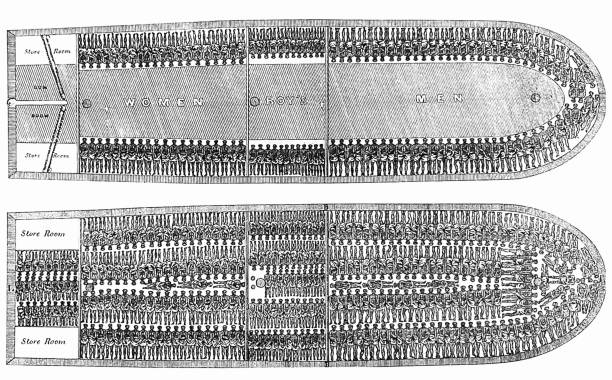
Image Credit: Brooks (or Brook, Brookes, or Bruz) was a British slave ship launched at Liverpool in 1781. Illustration from the 19th century.
So, what do we mean by the new Europe in the ‘slave’ ship?
This, nevertheless, may be among those ephemeral tendencies in the subject of nation’s power that historians have tried in the past decades to decease in quid pro quo over the superiority of the Western pieces of literature which presented Europeans as the architects of the ships used to convey African slaves through the trans-Atlantic route. No doubt, there are shreds of evidence to buttress this argument. The new Europe is claiming to find unity or portraying the gestures of ‘holiness’ amid the military operations in Ukraine by the Russian government in early 2021. An action that has gained upper recognition in the comity of nations. The Russian-Ukraine debacle has exposed how sordid the constructed bird’s nest in Europe was, and the inability of the supposed unity to take the “short man” to the cleaners shows European disunity. There should not be claims of “unity” when the real architect of the division is walking in the street in high demand.
There are divergent perspectives on the notion of European participation in the slave trade. I would offer my opinion not as an African but rather as an individual who finds himself in the European ship. “The European involvement in the slave trade dates back to the 15th century, but it was during the modern era that slave ships became a profitable enterprise.” Europe’s involvement in the slave trade during the modern era was driven by economic interests and the desire to exploit Africa’s resources. The reoccurrence and persistence in this venture surmised the argument. Ships were used to transport enslaved Africans to the Americas, where they were forced to work in plantations and mines. The brutal conditions on board these ships and the legacy of the slave trade continue to impact African societies and the descendants of enslaved Africans in the Americas to this day. European colonizers forced Africans to work in mines, plantations, and factories, extracting and producing raw materials that were then exported to Europe. The forced labor of Africans contributed significantly to Europe’s economic growth. The slave trade was eventually abolished in the 19th century, with Britain leading the way in outlawing the trade in 1807. Other European countries followed suit, and the transatlantic slave trade officially ended in the 1860s.” The abolishment led to the emergence of ‘legitimate commerce.’ However, the legacy of the slave trade continues to impact African societies, as well as the descendants of enslaved Africans in the Americas.
The slave ships used during the slave era to evacuate Africans from their homes were not vacuumed. “The ships were designed to transport large numbers of enslaved Africans in cramped and unsanitary conditions. The slaves were often shackled and packed tightly into the ship’s hold, where they were forced to lie on their sides for months at a time. The conditions on board the slave ships were brutal, with disease, malnutrition, and physical abuse being common. The slave ship and its social relationship have shaped the modern world, but their history remains in many ways unknown.” Many have argued this movement to be the first migration story in human history.
In conclusion, foot soldiers are being raised somewhere by nature. They can’t be seen but can be felt and their presence is yet to be registered. Europe is unsure and fragmenting. Tremendous power contention subverts expectations. The Europe of today is gradually winding into the new ‘slave ship’ designed by the forerunners of modern technology through the instrumentality of the convincer (slaves). The ships are sophisticated, larger, and move fast. The slave ships are institutions, politics, sets of rules, morals, ethics, norms, codes, procedures, unbecoming like fingerprint and CCTV, wanting, discoveries, trespasses, structures, government bodies, education systems, religion, financial systems, impediments, racism, gender inequality, protests, etc. These institutions are trapping the ‘new Europe’ and are setting the agenda for the raison d’être in the commerce of decoloniality being exposed all over the oven. For the interest of this paper, the slave ship in this context is not “a-contextual or political.” It’s not merely the innocuous notion that the new Europe is drifting from the democratic paradigm. These are the “becoming” and the “posthuman dulcet of this sunken queer in the new European accidental homes.”
Finally, what time of day it is, with you? As Dougald Hine expressed, “In this time all we can do is to be assigned,” a father tells his daughter in the novel titled “The Freedom Artist.” The author’s purpose is not to instill panic or to predict Europe’s doom shortly; the piece is far from that. I write for everyone who, like me, has discovered themselves and is trying to make sense of what is to come, and how to talk about it. Something is on the horizon, a humiliation from which none of us will be spared, and which may not be managed or controlled.
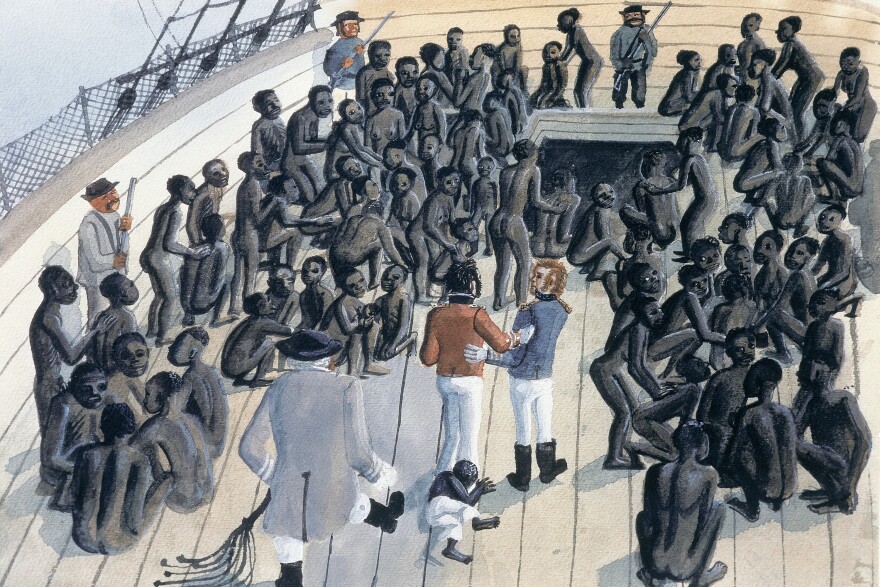
Image Credit: DEA/G.DAGLI ORTI/De Agostini in Jeff Cohen’s work on the Transatlantic Slave Trade
