
…traveling through the lonely road.
By Compassion Chidozie
“I prefer walking in the streets when I need to think. While walking, I mutter publicly my thoughts to unknown listeners, discussing with the wind and unseen angels. The main streets of Rome are in opposition to what I anticipated — calmness and solitude. They are congested that you would create a path to avoid scratching your body with someone walking in the opposite direction. Rome and I are separate entities. It does not belong to me; it is a beautiful city far from who I was.”
I have initiated traveling as a member of my hobbies family, and I admire people who buy into the pleasure of visiting many countries while creating happiness for themselves. Liturgically, these are people empowered by the universe to ‘learn’ and ‘become’ themselves. Their mental state would be akin to the encyclopedia’s topography. As for me, I like going to unknown places to meet my fears while discovering new things. This, however, has informed my curiosity to realize that there are other ways of knowing — against what the capitalist system taught us.
My childhood upbringing is akin to the wildlife in the Safari, dominated by the bigger mustache of the jungle kings. It denied me the experience of sightseeing in other climes, denied the sheer benefit of learning from cultures alien to mine. I lacked the opportunity to tour new frontiers, which impacted my worldview. And I have no one to blame for this. I have accepted my fate a long time ago. Making progress, my adulthood was different, though. It entails a cesspool of gradual unlearning and relearning of the ‘foundations’ of the past and the trauma that ensues from the process. I was hunted by the elves of the past. Finding myself in Western Europe, optically increase my devotion to what Michel Foucault called “seeing” and “speaking.”
Standing on top of Monte Amiate, 1,790 meters, making it the highest mountain in the city of Tuscany, Italy, which is a popular spot for hiking and skiing, a masculine voice whispered questionably, “Hey, Compassion, have you visited Rome?” No, I supplied. As the conversation deepened, I realized that I was the only person that has not tried the route to Rome, the old Vatican City, which registered the presence of the Catholic Institution, hosting iconic and remarkable monuments such as The Colosseum, Piazza di Porta Capena, Trevi Fountain, The Pantheon, etc. The descriptions given to Rome based on its fragility entail the power Europeans shared in architectural designs. “Since I am in Italy, why not?” I muttered to myself.
Ideally, Italy is a country with a strong affiliation with colonialism and slavery. After spending some weeks in Tuscany with my friends, I embarked on a trip to the Vatican City, but first made a single stop in Bologna. In Bologna, I was asked to be protective (watch out for thieves) on the streets to avoid attracting pickpockets. ‘This is Europe, do they have pocket pickers or pickpockets here?’ I queried myself. Spending quality time in some local communities whose residents speak only Italian, I was amazed at my discovery. Comparatively, Western European cities like Berlin and Rome are two different sides of the coin – socio-cultural and political. Architecturally, there are similarities: the same pattern of houses built without space — that span from the 18th Century architectural design, wall clusters against each other, public tap waters in major roads for those who are thirsty, the trope of ‘newcomers,’ and the taxonomy of immaterial substances.
During my first month in Germany, the people I met at public places like train stations, university cafes, gymnasiums, and theatres, whom up till this moment maintained proximity with me have never ceased to amaze me with existential questions enticed by their curiousness to inquire about my perception of Berlin as a person of skin color, a person from the other divide– living at the country’s capital. ‘I have not visited Berlin, but I hope to do so in the future,’ I answered, to stop further questions from coming. However, it didn’t stop coming. Meeting the same question again by the ‘unfamiliar’ informed me about a segment of species showcasing the prideness domicile in their ways of life and livelihood.
Another voice shrugged from another distance, “Visit Berlin, there are strong Black communities, and you will like it.” This conversation was taking place in Italy. Interestingly, the admirers of Berlin skipped mentioning the cost of living in Berlin. I was nonchalant in asking, regarding the fascinating preponderance of the history of the city, including the storytelling of the Berlin Wall that marked the border between the districts of Mitte (East Berlin) and Kreuzberg (West Berlin) as one of the tourist sites. Anyone in Berlin would love to see the Berlin Wall. The pre-pandemic benchmark shows Berlin’s tourism revenue climaxing as high as €10.58 billion, illustrating the city’s potential for revenue generation. Discourse of the Berlin Wall should not be in this story, but it is mostly ‘unstoried’ to discuss Berlin without mentioning the Wall.
Back to the happenstance of Italy. known for artistic and cultural influence, good foods like Spaghetti alla Carbonara, Truffles, Lasagne, and famous Gelato. I was fed enough Gelato ice cream — first time licking an Italian product of its kind. The food was lecker yet expensive, and their major streets were clustered with English speakers who I guessed were tourists. I saw more Brits, Americans, and a few Romans in Rome. Where do they hide? Collecting royalties from the systematic tourism infrastructure. According to Rome Business School (RBS) & Tourist Italy (2023), the leading websites documenting every entertainment activity in Italy, in 2023, there were 35 million visitors in Rome, generating €17.1 billion for the city. Can you beat that? This is a public record, yet tourists continued to contribute to the Italian tourism sector.
Again, let us bring it home. From the cultural comparative analysis, historically, Rome shares different political advantages and forms of government with the Igbo ethnic society in Africa, where I hail from. The Igbo political setting was both a liberal democracy and an acephalous entanglement, while the Roman Republic was a just democracy with an empire, as archival books announce. The government consisted of the Senate and four assemblies: the Comitia Curiata, Comitia Centuriata, Concilium Plebis, and Comitia Tributa. Rome’s government was a representative democracy in the form of a republic. Rome’s wealthiest families, the Patricians, held power and only they could hold political or religious offices. However, this was different in the Igbo political system; there was no representative government, and the people gathered at the village square to make decisions unanimously affected them. Here, every concern is articulated by all and sundry. All voices are heard, signalling equity and equality.
Upon arriving at Roma Termini (International Train Station) at 6 pm, from a distance, I was profiled by four able-bodied young men whom I later identified to be Senegalese. My side-eyes jamming with theirs, I sensed danger. Immediately, they realized that I was new in the city, and they hooked a visible GPS on me to track my movements with the intention of ‘obtaining’ my belongings at a boring or quiet site. A colored skin man of 5.8″ (183 cm) approached me demanding money. He spoke in French. ‘Ich spreche kein Französisch,’ I replied in German to confiscate the talk or dominate the conversation. I intended to appear unattractive to them, but their minds were already made up to take my wallet.
Quickly, I got on a bus number 170 (Agricoltura) going towards my hotel, and two guys amongst them marched ahead with me, their eyes fixed on me. Even a flick of my eyelash was captured by them. I consulted Google Maps for easy manipulation of my direction to confuse them from losing sight of my shadow, then I swiftly climbed out of bus 170 and followed bus number 44 (Montalcini) heading to Ripa/Ripense with zero seconds left before departure. I timed my transverse — my transformation. They must have blamed themselves for neglecting my capabilities. I disappeared into thin air. They lost sight of my shadow.
What is Coming Next?

Chinua Achebe (1965) while writing on the reality of foreign language in Umuofia village in his article titled “English and African Writer” asked the real question of whether Africans should communicate in the English language, since ontogenetically, the African language has been eroded and dominated by the colonial language like English, Spanish, Arabic, and Dutch. Is it right that a man should abandon his mother tongue for someone else’s? It looks like a dreadful betrayal and produces a guilty feeling.
This was the same fabric of thoughts that produced the eccentric feeling when I was walking from street to street in search of African delicacies after online Google Maps failed to show me “African Mama-Put” in Rome, the main reason for my outing. As big as Rome, there must be a ‘Mama-Put’ hidden somewhere from the public eye. I was worried. I was not interested in searching for African cuisine. The history of slavery, stories of African settlement and resettlement, colonialism and migration piqued the thoughts of being greeted by salivating African restaurants in Rome. I was mindedly satisfied that I would find one or many. I had thought about the city of Rome to be an appendage of Lagos Street food and the early morning food hunt by local transporters along the Enugu Expressway in Nigeria. Unfortunately, I was welcomed by the famous Italian Pizza and Pasta.
Rome tried to intimate the presence of the continent of Africa in the firmament of toponymy vis-à-vis their roles in colonialism. An appearance I motioned to be a plea to the Motherland against their injustice to Africans during slavery and extractivism. As Scego, Igiaba writes, Rome also has an African quarter: Viale Somalia, Viale Libia, Via Dire Dauda, Via Migiurtinia, Via Tripoli, Piazza Amba Alagi, Viale Etiopia, Via Cirenaica, Via Tigré. These are African names with strong meanings embedded in African history. They are present in the streets of Rome.
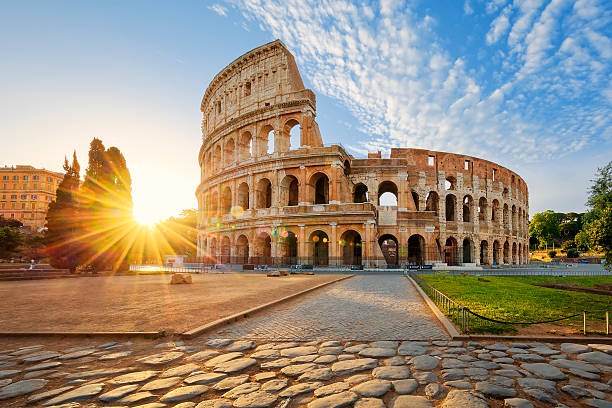
The next day, I went for a walk to get the gift from the Colosseum. I saw houses, occupied by natives, with windows covered in red-colored curtains to protect the internal doings of the inhabitants. Fyodor Mikhailovich Dostoevsky’s 1866 novel entitled Crime and Punishment came into my mind. Surprisingly, I jettisoned the notion of seeing the aesthetic of Rome, so I moved to see the ghetto in Rome – the dark side of the track. I learned this when I was in Brussels. The ghetto was decorated with graffiti showing covert gangs with warning signs of your limit as a visitor. The posterior looks satisfying to the deafening mind. It was good art decoration, so long as I didn’t have to live there. It was dominated by people of color, different races, and a few Italians, who I assume could not afford to rent flats in the city center or who prefer mixing with other cultures.
In the ghetto side of Rome, I expected to see hawkers selling African products like black cream and black powder at the roadside. I anticipated seeing Malian and Congolese women standing close to graffiti, wrapping their children on their backs, and waving their hands to passersby in the form of a call to patronize them. Many of them are skilled in the trade of hair weaving. This was a common craft I also noticed in Paris, France. I am yet to study why European countries with a record of a high rate of asylum seekers are inundated with such a trade.
Many abandoned houses and nobody stares at anyone – people go about their businesses wearing half-tethered and ungrateful smiles on their faces. Ah, freedom. Rome may not be to everyone’s taste, but the best way to navigate and get the trudges of the city is to surrender to it and allow yourself to be carried away along by its audacious adventure. I understand that leaving a journey ‘incomplete’ means not closing the door of opportunity. I hope to return to Rome — this time, with the Octopus as my seer — to complete the journey. I would like to investigate the guys who tracked me from the central rail station to ‘obtain’ my belongings. I would like to know what inspires them.
Image credit: vwalakt
