
I wish that friendship should have feet, as well as eyes and eloquence. It must plant itself on the ground, before it vaults over the moon. I wish it to be little more of a citizen, before it is quite a cherub.
~ Ralph Waldo Emerson
Discourse about the Anthropocene is ‘becoming’ complex and technical and is being inundated by ideologies from different categories of people. This is not a mistaken act, but rather an occurrence witnessed whenever there is a venir compromise of knowledge. The foundation of the compromise started in the early period when inter-global (not international) and inter-national bodies or institutions were set up for the protection of the ‘Upper Bodies’ against attacks from the ‘Lower bodies’, whose gestures have been creolized by history, willingly. This might sound radical, but it was proven behaviorally when terminologies like First, Second, and Third Worlds were constructed to border identities against each other.
As a curator of this story, the obsessive assumption that the Lower bodies are a threat to the Upper bodies worries me a lot, because this assumption is false. Before the quest for civilization was broccolized, it was documented, historically, that both bodies coexisted, and all lingering issues were kept at bay. Anthropocene has become a daily gesture, an occurrence for the wild-living posturing intersectionality to onboard perspectives. If that is not true, why is the global discourse footnoted by human health, economic cost, climate change, reducing greenhouse gas emissions, and maintaining biodiversity?
I would not want this article to be understood from the (beginning and ending) standpoint of the anthropocentric firmaments per se, but it is obvious that such a discussion on animals and human relations or when a yardstick is constructed by scientists to measure how animals and humans relate with each other cannot be fully discussed without intersecting the creed of the anthros. I am authorized by the goddess of the coronavirus (-the use of small caps for coronavirus means my failure to idolize the goddess, emphasis mine) to juxtapose this with the story of the “unleavened bread” of the New World and the “leavened bread” of the Old World, which crisscross Passover.
To borrow from the nomads of the Jewish text, when the Israelites were ‘commanded’ to eat the unleavened bread during the Passover celebration to commemorate their hurried departure from Egypt, where they did not have time for the bread to rise, this is when the anthropocene becomes a distortion. Chinua Achebe talks about “how a knife was put on the things that held us together and we have fallen apart.” The ‘arrival’ of Achebe is what I rudely called the Igbocene (a virgin concept yet to be leavened). A permutation of ‘identified crisis’ omnipresence from the top-down hierarchical assemblages.
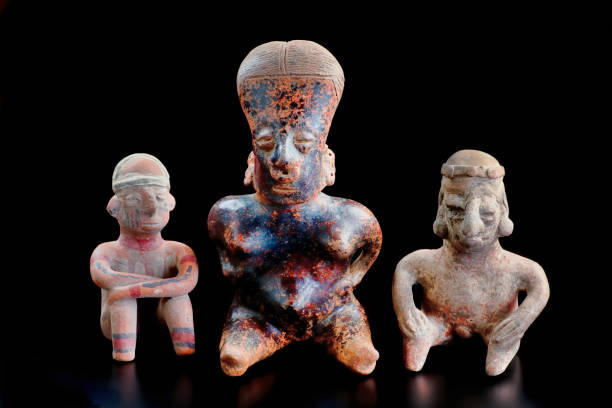
Real Pre-Columbian clay figurines made around 200 BC to 200 AD
The valorization of (human) ideology in this epoch is not the answer to the questions of the anthropocene. Why animals and other ‘seen’ and ‘unseen’ variables/beings are taking in a puerile shape more than humans indicates my inability to answer the question this article asked. I mean, “the devil is in the details” if we are to borrow Gustave Flaubert’s (1821-1880) popular expression that “things seem simple at first but are more complex or require more time” to be unraveled. Poignantly, my sense of reasoning is indicted in the question.
Catherine Johnson (2009), in her book entitled “Animals Make Us Humans: Creating the Best Life for Animals,” asks what does animals need (from humans) to be happy? This question was decorated with moves by the British government to set up a commission that came up with a report on animal production intensification. The report listed five freedoms that animals must enjoy. The first three freedoms are about physical welfare, including freedom from discomfort, freedom from hunger and thirst, freedom from pain, injury, or disease, freedom to express normal behavior, and finally freedom from fear and distress. I agree with Catherine that animals, just like people, have emotions. I highly recommend the book.
Animals raised in open fields like forests (wild) tend to have higher intelligence and problem-solving skills than those raised in a cage. A Canadian research psychologist, Donald Hebb, in the 1940s, experimented with rats to prove this theory. Take this as a reversal experiment, let’s say a situation where humans are raised in a cage or a barren environment, what do we think would happen to their cortex (brain growth)? I guess a neuroscientist can provide answers to this question. This was why Tibor asks, “How do we establish that we are the most important or valuable kind of being?” Warren (2017) talks about the rights of the nonhuman world in her book entitled “All Animals Are Equal.”
Machan Tibor (2002), considers that animals are used for human purpose because the human species think of themselves as more important or valuable than other animals and some of our (human) activities may require the use, even killing, of animals in order to succeed at our lives, to make it flourish most. The human species is considered to be prima facie more than other species, which, by the way, have been ridiculed by some scientists. Animals or plants are not alien to our place of abode. Extensively, humans are the ‘others’ – to express that we are alien to this place of abode before our dictatorial instincts became contentious.
Horizoning into the question by Vicki Kirby (2018): can we condemn anthropocentrism and human exceptionalism on the one hand, and accuse humans as the ultimate culprits on the other hand? To draw a cursory line, in understanding the world, it is significant to note that humans and animals inhabit the same world, the same prioritized world; as living beings, they share in common the limitations and boundaries of their lives, and therefore, among other features of mortality. Despite not having the same civilizing experiences, the differences between them are essentially unbridgeable. I declare, animals are poor in this world. Humans made animals to be poor.
The philosophical perspective that assigns recognition, moral and ethical value to animals rather than humans is known as animalism, broadly speaking, biocentrism or species egalitarian ideology. There is nothing wrong with assigning yourself to the cleavages of an activist and savior of those whose voices are lost. While I endorse the activism around it, I don’t want to be perceived as any of this — a spokesperson of the animal world — I don’t want to be either recognized as a rights activist or a member of the animal welfare association. However, I want us to be mischievous and tinker alongside the barriers set by human beings against the ‘escape’ of animals, to capture the intricacies and intimacies of nature’s self-involvement and how it produces itself.
Image credit: clu via iStock photo
